Which penguins are in trouble?
Climate change, food shortages, dogs, nets and disease. Here is what the sources say, and every species’ IUCN Red List category on the day we checked.
Sea ice and the emperor
Emperor penguins rely on sea ice for almost nine months of the year, to breed and raise their young. WWF-UK: Emperor penguins WWF-UK says the biggest threat to emperors right now is climate change, through changes in the sea ice they depend on. WWF-UK: Emperor penguins
WWF-UK reports studies showing that, if current emissions continue, emperor numbers could crash by about 50% by 2080. WWF-UK: Emperor penguins · checked 27 Oct 2026
- Emperor penguin: Near Threatened on the IUCN Red List (last assessed 2019). Population trend: decreasing. IUCN Red List: Emperor penguin · checked 27 Oct 2026
- The Australian Antarctic Division’s emperor penguin page gives its conservation status as endangered, and expects a moderately rapid decline over the next three generations because of climate change. Australian Antarctic Division: Emperor penguin · checked 27 Oct 2026
- National Geographic’s emperor penguin page lists it as Near Threatened with a current population trend of ‘stable’. National Geographic: Emperor penguin · checked 27 Oct 2026
The IUCN Red List is the global standard; other pages may use older or national assessments. Every disagreement we found →
Less krill
Recent evidence suggests chinstrap numbers are falling significantly because of reductions in krill, their main food. Australian Antarctic Division: Chinstrap penguin
Dogs, cats and stoats
Dogs are likely the greatest threat to little penguins in New Zealand. Cats, ferrets and stoats also kill them. NZ Department of Conservation: Little penguin/kororā In New Zealand, the little penguin’s status is ‘At Risk–Declining’. NZ Department of Conservation: Little penguin/kororā · checked 27 Oct 2026
On Middle Island in Australia, Maremma dogs guard little penguins from foxes, a story told in the film Oddball. Smithsonian Ocean: Penguins
The hoiho
Hoiho face disease, predators, starvation, set nets, dog attacks and climate-driven changes in their food. NZ Department of Conservation: Yellow-eyed penguin/hoiho The northern population of hoiho fell from about 741 breeding pairs in 1999 to 265 in 2019, a 65% fall in 20 years. NZ Department of Conservation: Yellow-eyed penguin/hoiho · checked 27 Oct 2026
In New Zealand’s own threat system, the hoiho is ‘Threatened–Nationally Endangered’, with 4,000–5,000 mature individuals in 2019. NZ Department of Conservation: Yellow-eyed penguin/hoiho · checked 27 Oct 2026
The African penguin
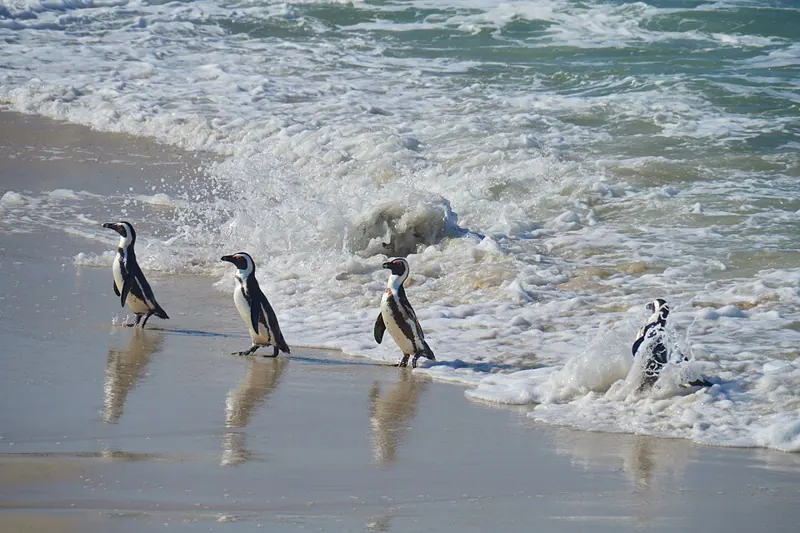
The Smithsonian says there are below 200,000 African penguins, compared with 1.4 million at the start of the twentieth century. Smithsonian Ocean: Penguins · checked 27 Oct 2026 The Smithsonian notes that, as of 2024, the IUCN lists the African penguin as critically endangered. Smithsonian Ocean: Penguins · checked 27 Oct 2026
Protection
Chinstrap penguins that live south of 60° South are protected under the Antarctic Treaty System. Australian Antarctic Division: Chinstrap penguin
Every species on the Red List
Copied from each species’ IUCN Red List page, checked 27 Oct 2026. Categories change when species are reassessed, so each line says when it was last assessed.
| Species | Red List category and trend |
|---|---|
| Emperor penguin | Emperor penguin: Near Threatened on the IUCN Red List (last assessed 2019). Population trend: decreasing. IUCN Red List: Emperor penguin · checked 27 Oct 2026 |
| King penguin | King penguin: Least Concern on the IUCN Red List (last assessed 2020). Population trend: increasing. IUCN Red List: King penguin · checked 27 Oct 2026 |
| Adélie penguin | Adélie penguin: Least Concern on the IUCN Red List (last assessed 2020). Population trend: increasing. IUCN Red List: Adélie penguin · checked 27 Oct 2026 |
| Gentoo penguin | Gentoo penguin: Least Concern on the IUCN Red List (last assessed 2019). Population trend: stable. IUCN Red List: Gentoo penguin · checked 27 Oct 2026 |
| Chinstrap penguin | Chinstrap penguin: Least Concern on the IUCN Red List (last assessed 2020). Population trend: decreasing. IUCN Red List: Chinstrap penguin · checked 27 Oct 2026 |
| Macaroni penguin | Macaroni penguin: Vulnerable on the IUCN Red List (last assessed 2020). Population trend: decreasing. IUCN Red List: Macaroni penguin · checked 27 Oct 2026 |
| Royal penguin | Royal penguin: Least Concern on the IUCN Red List (last assessed 2021). Population trend: unknown. IUCN Red List: Royal penguin · checked 27 Oct 2026 |
| Southern rockhopper penguin | Southern rockhopper penguin: Vulnerable on the IUCN Red List (last assessed 2020). Population trend: decreasing. IUCN Red List: Southern rockhopper penguin · checked 27 Oct 2026 |
| Northern rockhopper penguin | Northern rockhopper penguin: Endangered on the IUCN Red List (BirdLife’s factsheet gives 2020 as the last assessment). Population trend: decreasing. BirdLife International: Northern rockhopper penguin factsheet · checked 27 Oct 2026 |
| Fiordland penguin | Fiordland penguin: Near Threatened on the IUCN Red List (last assessed 2020). Population trend: decreasing. IUCN Red List: Fiordland penguin · checked 27 Oct 2026 |
| Snares penguin | Snares penguin: Vulnerable on the IUCN Red List (last assessed 2018). Population trend: stable. IUCN Red List: Snares penguin · checked 27 Oct 2026 |
| Erect-crested penguin | Erect-crested penguin: Endangered on the IUCN Red List (last assessed 2020). Population trend: decreasing. IUCN Red List: Erect-crested penguin · checked 27 Oct 2026 |
| Yellow-eyed penguin (hoiho) | Yellow-eyed penguin: Endangered on the IUCN Red List (last assessed 2020). Population trend: decreasing. IUCN Red List: Yellow-eyed penguin · checked 27 Oct 2026 |
| Little penguin (kororā) | Little penguin: Least Concern on the IUCN Red List (last assessed 2020). Population trend: stable. IUCN Red List: Little penguin · checked 27 Oct 2026 |
| African penguin | African penguin: Critically Endangered on the IUCN Red List (last assessed 2024). Population trend: decreasing. IUCN Red List: African penguin · checked 27 Oct 2026 |
| Humboldt penguin | Humboldt penguin: Vulnerable on the IUCN Red List (last assessed 2020). Population trend: decreasing. IUCN Red List: Humboldt penguin · checked 27 Oct 2026 |
| Magellanic penguin | Magellanic penguin: Least Concern on the IUCN Red List (last assessed 2020). Population trend: decreasing. IUCN Red List: Magellanic penguin · checked 27 Oct 2026 |
| Galápagos penguin | Galápagos penguin: Endangered on the IUCN Red List (last assessed 2020). Population trend: decreasing. IUCN Red List: Galápagos penguin · checked 27 Oct 2026 |
- Royal penguin: Least Concern on the IUCN Red List (last assessed 2021). Population trend: unknown. IUCN Red List: Royal penguin · checked 27 Oct 2026
- The Australian Antarctic Division’s royal penguin page gives its conservation status as near threatened. Australian Antarctic Division: Royal penguin · checked 27 Oct 2026
- A Britannica picture caption calls the royal penguin vulnerable because its breeding area is so small. Britannica: Penguin · checked 27 Oct 2026
Three sources, three different answers. Every disagreement we found →
What helps
New Zealand’s advice: leave penguins alone (scruffy birds are usually just moulting) and keep dogs on a lead near penguin areas. NZ Department of Conservation: Little penguin/kororā Support the scientists and conservation groups who count and protect penguins, such as the Australian Antarctic Division and New Zealand’s Department of Conservation.