Built for the water
Penguins swap flying in air for flying underwater. Here’s the kit: feathers, fat, flippers, a salt filter and eyes tuned for the sea.
Flippers and a rudder
Penguins are flightless birds, highly adapted for life in the sea: excellent swimmers that can dive to great depths. Australian Antarctic Division: Penguins Penguins use their feet and tail as a rudder, and push themselves along with their flippers. Australian Antarctic Division: Penguins
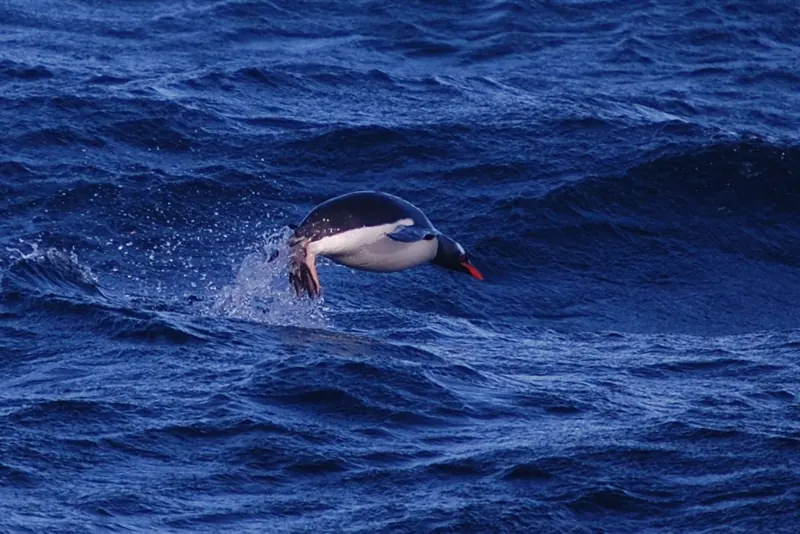
Travelling penguins often ‘porpoise’: a series of shallow leaps across the surface, named after the way porpoises swim. Smithsonian Ocean: Penguins
How fast?
Most midsize penguins swim at around 5 mph (8 km/h), and the little penguin pootles along at about 1 mph (1.5 km/h). Smithsonian Ocean: Penguins New Zealand’s Department of Conservation says little penguins ‘fly’ through the water at up to 6 km/h. NZ Department of Conservation: Little penguin/kororā
- The Smithsonian says the fastest penguin, the emperor, can reach 9 mph (14 km/h) in a hurry, though it prefers a steady 7 mph. Smithsonian Ocean: Penguins · checked 27 Oct 2026
- Britannica says gentoo penguins are the world’s fastest underwater birds, reaching up to 36 km (about 22 miles) an hour. Britannica: Penguin · checked 27 Oct 2026
Different measures: steady cruising speed versus top speed. Every disagreement we found →
How deep?
On average, penguins dive to between 9 and 18 m (30 to 60 feet). Smithsonian Ocean: Penguins King penguins frequently dive to 91 m (300 feet). Smithsonian Ocean: Penguins
- Emperor penguins mostly hunt 150 to 250 metres down. The Australian Antarctic Division gives the deepest recorded dive as 565 metres. Australian Antarctic Division: Emperor penguin · checked 27 Oct 2026
- The Smithsonian says emperor penguins can reach depths of around 518 m (1,700 feet). Smithsonian Ocean: Penguins · checked 27 Oct 2026
- Britannica says emperors can dive to about 550 metres (1,800 feet), which makes them Earth’s deepest-diving birds. Britannica: Penguin · checked 27 Oct 2026
- The IUCN Red List entry for the emperor penguin gives its lower depth limit as 560 metres. IUCN Red List: Emperor penguin · checked 27 Oct 2026
Records change as more birds are tracked. Every disagreement we found →
- Emperor dives usually last 3 to 6 minutes. The Australian Antarctic Division gives the longest on record as 22 minutes. Australian Antarctic Division: Emperor penguin · checked 27 Oct 2026
- The Smithsonian reports a 2018 study that measured an emperor penguin diving for over 32 minutes, the longest bird dive recorded. Smithsonian Ocean: Penguins · checked 27 Oct 2026
The Smithsonian quotes a newer study (2018). Every disagreement we found →
A coat for the cold
Penguins have a waterproof coat of short, overlapping feathers and a thick layer of fat for insulation. Australian Antarctic Division: Penguins Emperors’ layered feathers are so good that it takes winds of over 60 knots (about 110 km/h) to ruffle them. Australian Antarctic Division: Emperor penguin
Penguins look after their feathers carefully, often preening for three hours a day, spreading waterproof oil from a gland at the base of the tail. Smithsonian Ocean: Penguins All penguins keep a body temperature of around 38 °C, but they live anywhere from 32 °C on the Patagonian coast to −60 °C on Antarctic sea ice. Smithsonian Ocean: Penguins
The tuxedo
The black-and-white ‘tuxedo’ is camouflage called countershading. From below, a white belly blends with the bright surface; from above, a black back looks like the dark deep. Smithsonian Ocean: Penguins
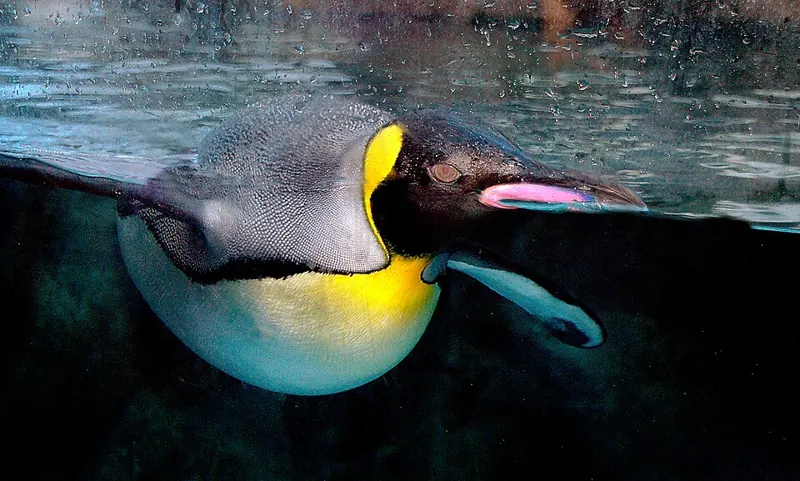
The yellow pigments in penguin feathers are unique to penguins. Australian Antarctic Division: Unusual penguins Some penguins are completely white but have dark beaks and eyes. These rare birds are called ‘leucistic’, from the Greek ‘leucos’, white. Australian Antarctic Division: Unusual penguins
The yearly moult
Every year a penguin replaces all its feathers, worn out by sun, sea salt and weather. This is the moult. Australian Antarctic Division: Unusual penguins
Some fiordland and rockhopper penguins have been found with barnacles growing on their feathers! Smithsonian Ocean: Penguins
Seawater on the menu
Penguins drink seawater with their food. Salt glands above the eyes filter it out, and a quick ‘sneeze’ and shake gets rid of the salt. Smithsonian Ocean: Penguins Yes, penguins can sneeze! The Australian Antarctic Division has filmed an emperor penguin doing it. Australian Antarctic Division: Emperor penguin
Senses
Penguin eyes are tuned towards violet, blue and green, and away from red, a colour that quickly disappears underwater. Smithsonian Ocean: Penguins Emperor and king penguin beaks reflect ultraviolet light, the only sea birds known to do so. Smithsonian Ocean: Penguins
Penguins can probably only taste salty and sour. A study found they lack the genes for sweet, bitter and umami tastes. Smithsonian Ocean: Penguins Studies of African, Humboldt and chinstrap penguins suggest some penguins can find prey by smell, such as chemicals released by feeding krill. Smithsonian Ocean: Penguins
Even when asleep, king penguins could tell the difference between the sounds of predators and harmless sounds in one study. Smithsonian Ocean: Penguins
Next: all 18 species →